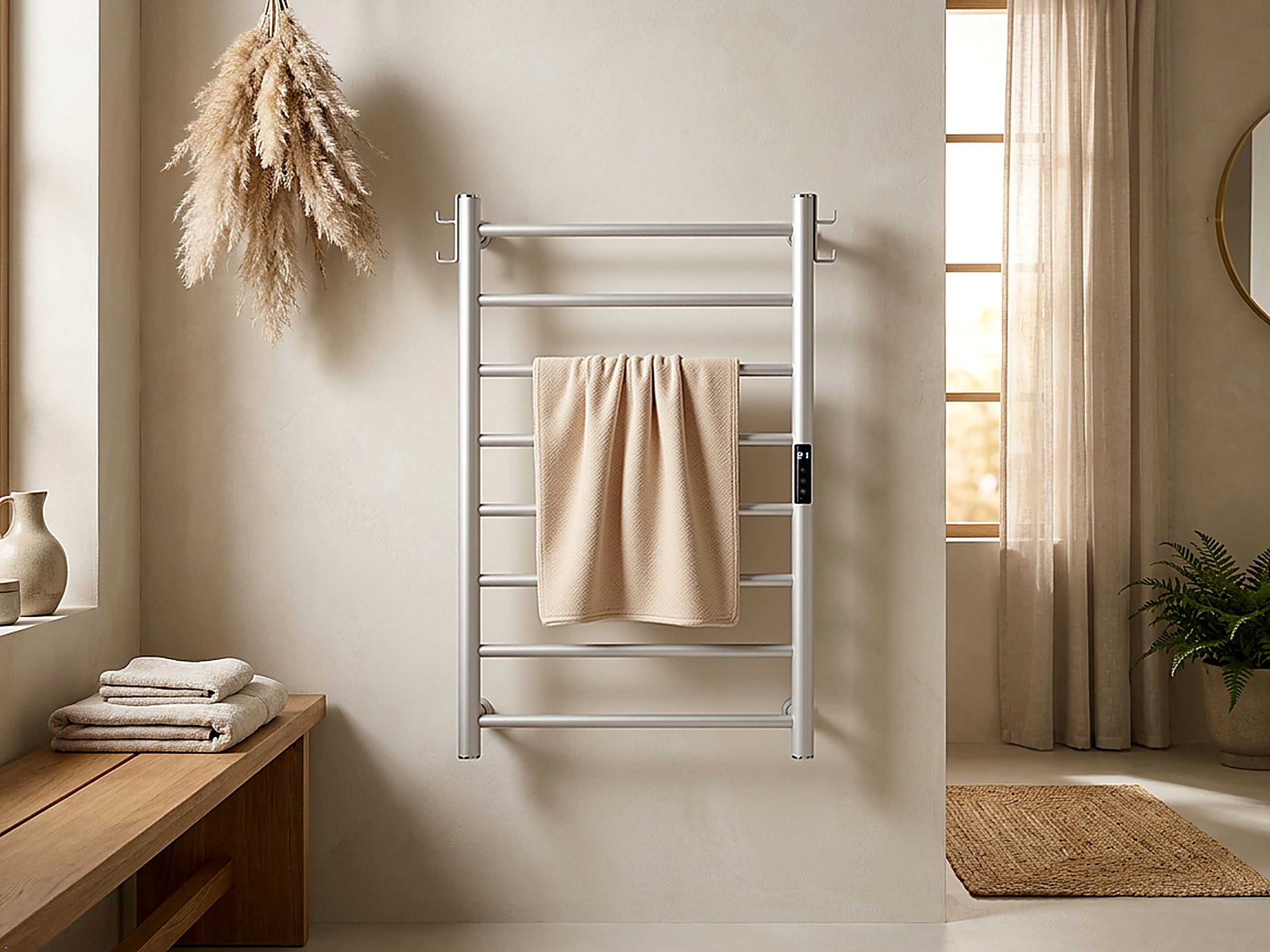
Most heated towel rack listings look identical — same lifestyle photos, same promises. The real differences hide in five specs, and if you check them in order, choosing becomes simple. Skip the ones that don't affect you; sweat the ones that do.
1. Voltage: the spec that decides everything
If you're in the US, start here. A large share of heated towel racks sold online are built for 220–240V systems — fine in Europe, Asia, or Australia, but a mismatch for US wiring. A 220V unit on a US circuit either won't reach rated output or simply isn't safe to connect.
What you want is a 120V model that plugs into a standard grounded bathroom outlet — the same receptacle style you already have. If the listing doesn't say "120V" or "US plug" explicitly in the spec table (not the photos), assume it isn't. If you'd rather hide the cord, some models can also be hardwired by an electrician, but plug-in should always be the default: it costs nothing to install and moves with you.
2. Size and bar count: match the rack to the wall, not the photo
Towel racks are sold by width and bar count, and this is where returns happen. The practical rule:
- Compact bathrooms or a single user: a small frame with about 5 bars is plenty for two towels plus hooks for a robe.
- A couple or a family bathroom: a mid-size frame with 8 bars keeps towels, bath mats, and kids' towels in rotation without pile-ups.
- Large towels, shared bathrooms, or laundry drying: go tall — 10 bars over a narrow footprint holds a full set without crowding the wall.
Measure the wall before you fall in love with a style: you need the stated width plus a few inches of breathing room on each side for towels to hang freely. A packed towel touches the neighboring one and neither dries.
3. Heat control: thermostat, timer, and a display you can read
A rack that's either "on" or "off" gets old fast. Three features separate a convenient one from an annoying one:
- Multiple heat settings. Around 104°F for gentle all-day drying, up to roughly 140°F for a hot towel out of the shower.
- A 1–24h timer. Set it to warm before you wake and switch off after you leave — you never pay for heat nobody's using.
- A visible display. A small LED on the frame beats a hidden indicator: you can confirm the setting at a glance instead of guessing.
4. Wet-room safety: the certifications and protection you can verify
Bathrooms are wet rooms, so safety is non-negotiable. Two things to look for in the spec sheet:
- IPX4 splash resistance — the rating that says the unit tolerates water splashes from any direction, which is what a bathroom actually dishes out.
- Built-in overheat protection — the unit should cut itself back if anything runs abnormally hot, not rely on your wall breaker.
And mount it as the manual recommends: high enough that the lowest bar clears typical splash zones, plugged into a GFCI-protected outlet like every bathroom receptacle in a US home should be.
5. Material and finish: what survives a steamy room
Heated racks live in a humid, temperature-swinging environment. Anodized aluminum handles that well — it resists corrosion without heavy coatings, stays light on the wall, and conducts heat evenly across the bars. Cheaper painted steel can chip at the joints and show rust within a season or two.
Finish is a taste call — matte white and black disappear into most palettes, brushed silver and champagne gold read more upscale — but check that the model includes side hooks. They're the difference between "towel rack" and "towel system": robes, loofahs, and hand towels live on the hooks while the bars stay in rotation.
A typical heated towel rack draws 95–165W — about as much as one or two old incandescent bulbs. Run for three hours a day, even the largest size costs in the region of a dollar a week at typical US electricity rates. The timer is what keeps it that low.
The 30-second checklist
Voltage: 120V, US plug. Size: measured wall + bar count for your household. Control: thermostat with real temperature steps and a timer. Safety: IPX4 and overheat protection. Build: anodized aluminum with side hooks. Any rack that clears all five will do its job for years — the rest is color.