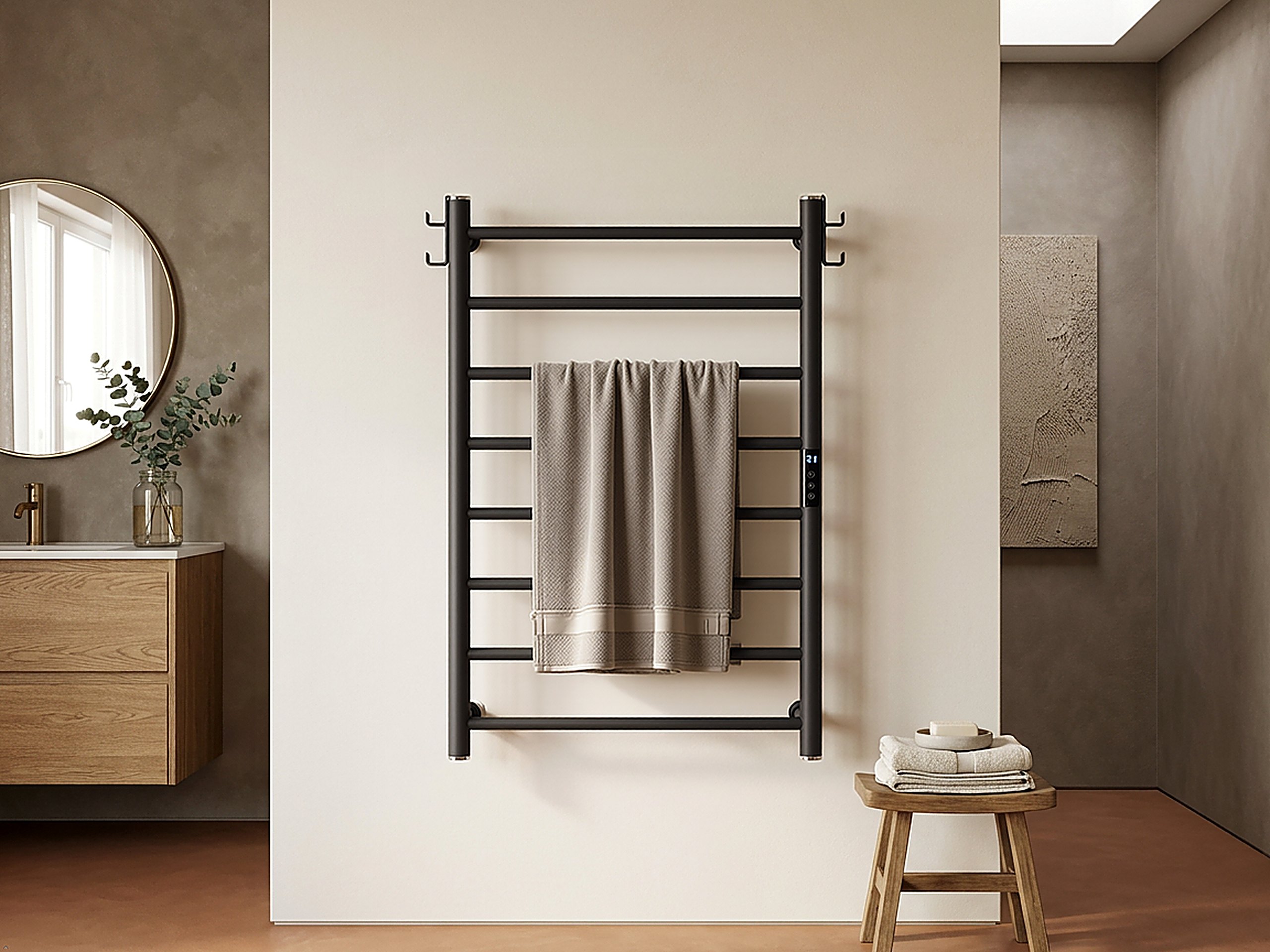
They're both metal, both warm, both mounted on a wall — so the question comes up constantly: do I need a radiator or a heated towel rack? The honest answer is that they solve different problems, and picking the wrong one is an expensive way to learn that.
The core difference: room heat vs. dry heat where you need it
A traditional radiator is a room heater. Its job is to raise the air temperature of a whole space, and it's sized in the hundreds or thousands of watts to do it.
A heated towel rack is a targeted appliance. It warms towels directly, dries them between uses, and takes the chill off the immediate zone around the shower and sink — where bare skin actually makes contact. It's measured in the tens of watts (roughly 95–165W for typical home models), not thousands.
A radiator heats the room. A towel rack heats the towel — and the towel heats you.
Running cost: an order of magnitude apart
This is where the comparison gets concrete. Take a typical US electricity rate of around 17–20 cents per kWh:
- Electric radiator, 1,500W: three hours a day ≈ $2.30–2.70 per week.
- Heated towel rack, 165W (large size): three hours a day ≈ $0.25–0.30 per week.
That's roughly a tenth of the cost, because a towel rack isn't fighting the whole room's air volume. If your goal is "warm dry towels and a bathroom that doesn't feel cold at 6 a.m.," paying radiator prices for it is waste.
Installation: outlet vs. project
A plug-in heated towel rack installs in under an hour with a drill, four screws, and a standard 120V bathroom outlet — no electrician, no permits, reversible if you move. A fixed electric radiator usually wants a dedicated circuit; a hydronic radiator ties into plumbing or a boiler loop. That's a remodel decision, not an accessory decision.
What each one is actually for
- Choose a radiator when the room has no heat source at all — a converted basement, an addition, a garage bath — and you need the air itself warm for long stretches.
- Choose a heated towel rack when the bathroom already has heat but the pain points are specific: damp towels that never quite dry, a cold tile zone, towels that smell musty by day three. The dryness problem is a comfort and hygiene problem, and a towel rack fixes it at the source.
The honest middle ground
Many people use a heated towel rack as supplemental warmth — on with the timer before the household wakes, the shower zone comfortable by the first shower, off after. It won't replace central heating in a Minnesota January. But in most US homes, the bathroom isn't cold because there's no heat — it's cold because the heat never reaches the tile zone. That gap is exactly what a low-wattage rack closes, at pennies a day.
Whole room, all day, no existing heat → radiator. Warm towels, dry towels, a warm start to the morning → heated towel rack. Remodeling from scratch, some households do both — the radiator for the air, the rack for the towels.
For US homes specifically
One more filter before you buy: whatever you choose must speak US electrical. The NALRZKH EA13, for example, is built for it — 120V with a standard plug, three heat settings from 104°F to 140°F, a 1–24h timer, and IPX4 splash resistance sized for real bathrooms in three widths (5, 8, or 10 bars). No 220V surprises, no electrician required.